There’s a specific frustration almost every business owner in India knows well. Money goes into marketing every month – some ads here, some social media there, maybe a few banners – and when someone asks “what did we get from it?”, nobody in the room has a clear answer.
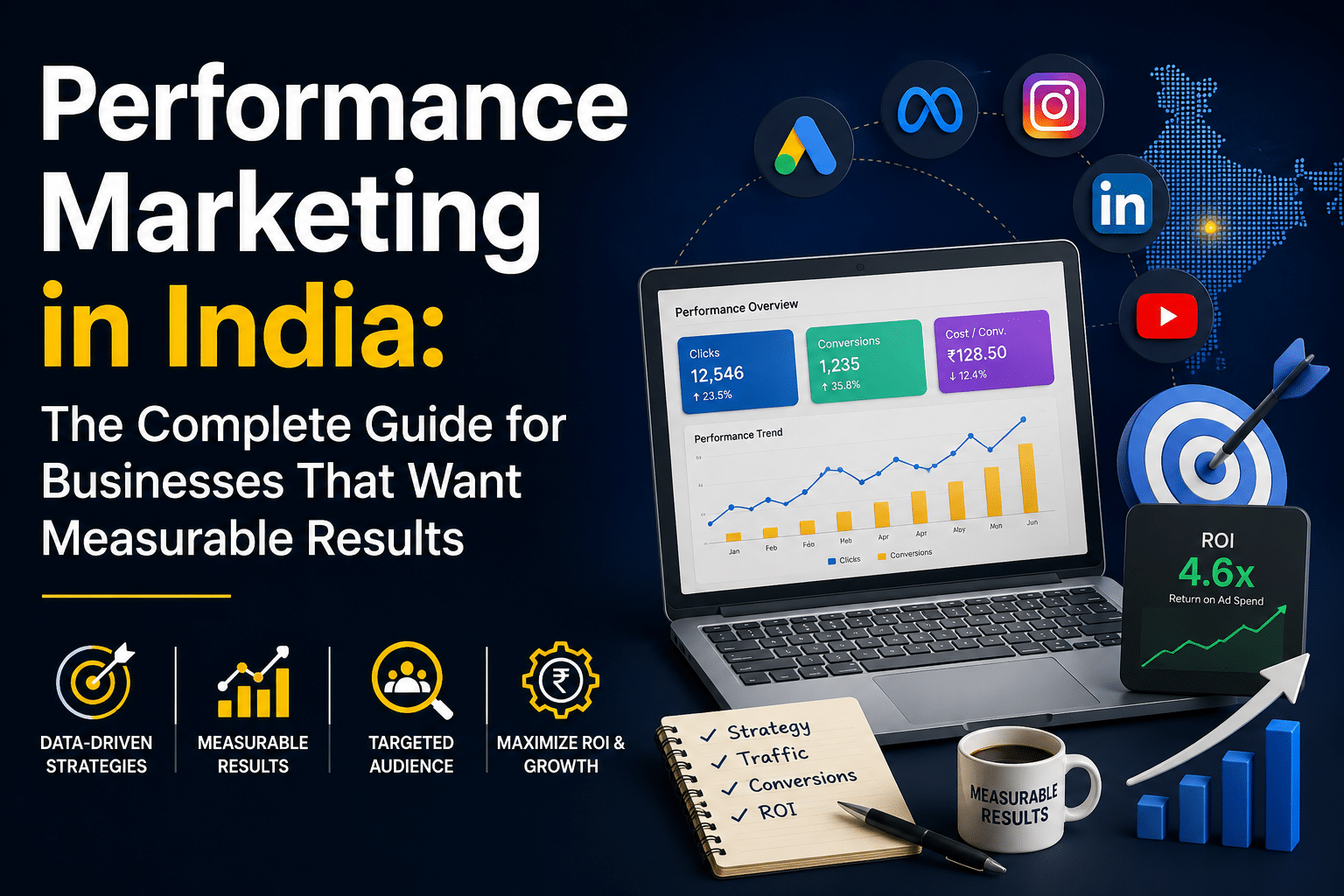
That frustration is exactly why Performance Marketing exists. It flips the old model on its head: instead of paying for visibility and hoping something happens, you pay for measurable outcomes – clicks, leads, sales, app installs, phone calls. Every rupee is tracked, every result is counted, and campaigns that don’t perform get fixed or killed.
It sounds obvious when you say it out loud. Yet most businesses in India are still running marketing the old way, spending on activities instead of outcomes. This guide breaks down what performance marketing actually means, which channels it covers, what it costs in India, and how to know whether your business is ready for it.
Table of Contents
Quick Overview: Performance Marketing Channels in India
| Channel | Best For | Starting Budget (Monthly) | Results Timeline | Key Metric |
|---|---|---|---|---|
| Google Search Ads | High-intent leads | ₹15,000 – ₹50,000 | 1–2 weeks | Cost per Lead |
| Meta Ads (FB/IG) | B2C, D2C, local business | ₹10,000 – ₹40,000 | 2–4 weeks | Cost per Lead / ROAS |
| YouTube Ads | Awareness + consideration | ₹15,000 – ₹50,000 | 3–6 weeks | View Rate, CPL |
| Shopping / P-Max | E-commerce sales | ₹20,000 – ₹1 Lakh | 2–4 weeks | ROAS |
| Remarketing | Recovering lost visitors | ₹5,000 – ₹20,000 | 1–2 weeks | Conversion Rate |
| LinkedIn Ads | B2B, high-ticket services | ₹25,000 – ₹80,000 | 4–8 weeks | Cost per Qualified Lead |
The pattern worth noticing: no single channel is “the best.” The right channel depends entirely on who your customer is and where they are when they’re ready to buy. A rebar coupler manufacturer and a chocolate brand should be running completely different playbooks.
What is Performance Marketing, Really?
Performance marketing is paid digital advertising where you pay for and optimize toward specific, measurable actions — a lead form submission, a purchase, a phone call, a WhatsApp enquiry, an app install.
Three things separate it from generic “running ads”:
- Everything is tracked. From the first click to the final sale, conversion tracking connects ad spend to actual business results.
- Decisions follow data. Ads, audiences and budgets change based on what the numbers say, not what looks nice.
- Accountability is built in. At the end of the month, the question “what did we get?” has an exact answer: X leads at ₹Y per lead.
In practice, performance marketing in India mostly means Google Ads and Meta Ads run properly — with real tracking, structured testing and weekly optimization — rather than the “boost post and pray” approach that wastes crores across the country every month.
Performance Marketing vs Traditional Digital Marketing
| Aspect | Traditional Digital Marketing | Performance Marketing |
|---|---|---|
| What you pay for | Activity (posts, banners, reach) | Outcomes (leads, sales, calls) |
| Measurement | Impressions, likes, followers | CPL, ROAS, conversion rate |
| Budget logic | Fixed monthly spend | Scales with what’s working |
| Timeline | Long-term brand building | Results in weeks |
| Risk | Hard to measure ROI | ROI visible in the dashboard |
| Best for | Brand awareness, trust | Lead generation, sales |
The honest take: businesses need both eventually. Performance marketing brings leads this month; brand and SEO make those leads cheaper next year. But if a business can only afford one thing and needs revenue, performance marketing is where the money should go first.
The Main Performance Marketing Channels
Google Ads (Search & Performance Max)
Search ads capture people at the exact moment of intent. Someone typing “box compression tester price” or “CLAT coaching in Delhi” isn’t browsing — they’re shortlisting. That’s why search consistently delivers the highest-quality leads for service and B2B businesses.
Performance Max campaigns extend this across YouTube, Gmail, Maps and Display automatically. They work well for e-commerce, but they need clean conversion data to learn from — running P-Max without proper tracking is like driving with the windshield painted over.
What good Google Ads management includes:
- Keyword and competitor research, not guesswork
- Negative keyword lists that keep junk clicks out
- Landing pages built for conversion, not just the homepage
- Call and form tracking connected to the account
- Weekly bid, budget and search-term reviews
Meta Ads (Facebook & Instagram)
Meta is where demand gets created rather than captured. People aren’t searching for your product on Instagram — but the right creative shown to the right audience makes them want it.
This makes Meta the strongest channel for B2C: D2C brands, coaching institutes, clinics, real estate, weddings, local services. Lead forms with WhatsApp follow-up work particularly well in the Indian market, where buyers prefer chatting before calling.
The single biggest factor in Meta performance today is creative. Audience targeting has become largely automated — the ad itself (especially video and reels-style creative) now decides whether campaigns win or lose.
YouTube Ads
YouTube sits between branding and performance. Skippable in-stream ads cost surprisingly little in India (often under ₹1 per view), making it powerful for businesses with a story to tell — courses, real estate, healthcare, high-ticket services.
The performance angle: YouTube audiences can be built from people who watched your videos and then remarketed on Google Search and Display, creating a full-funnel system instead of isolated campaigns.
Marketplace & Shopping Ads
For e-commerce, Google Shopping and marketplace ads (Amazon, Flipkart) are pure performance plays — the customer sees the product, price and rating before clicking, so traffic arrives ready to buy. ROAS (return on ad spend) is the only metric that matters here, and healthy campaigns typically target 4x–10x depending on margins.
Remarketing
Around 95–98% of website visitors leave without enquiring. Remarketing follows them with tailored ads across Meta, Google Display and YouTube, and typically delivers the cheapest conversions in the entire account — because these people already know you.
Any business spending on traffic without running remarketing is quietly leaking money.
The Metrics That Actually Matter
Performance marketing lives and dies by a handful of numbers:
- CPL (Cost per Lead): total spend ÷ leads. The core metric for service businesses.
- ROAS (Return on Ad Spend): revenue ÷ ad spend. The core metric for e-commerce.
- Conversion Rate: visitors who take action. Under 2% usually means a landing page problem, not an ads problem.
- Lead Quality / Closing Rate: 30 junk leads are worse than 8 genuine ones. Sales feedback must flow back to the marketing team.
- CAC (Customer Acquisition Cost): what a paying customer actually costs after closing rates are applied.
The metrics that don’t matter on their own: impressions, reach, likes and CTR. They’re diagnostics, not results. An agency report that leads with impressions instead of cost per lead is usually hiding something.
Performance Marketing Cost in India
Performance marketing has two cost components, and mixing them up causes most budgeting confusion:
| Component | Typical Range | Who Gets Paid |
|---|---|---|
| Ad Spend | ₹15,000 – ₹5 Lakh+/month | Google / Meta directly |
| Agency Management Fee | ₹10,000 – ₹50,000/month or 10–20% of spend | The agency |
Realistic starting budgets by business type:
- Local business / clinic: ₹20,000 – ₹35,000/month total (spend + management)
- B2B / service business: ₹30,000 – ₹60,000/month, search-led
- D2C / e-commerce brand: ₹50,000 – ₹1.5 Lakh/month, Meta + Shopping led
- Coaching / education: ₹30,000 – ₹80,000/month, Meta + YouTube + Search
One honest budgeting rule: keep enough spend for the platform to learn. A ₹5,000/month Google Ads budget in a competitive industry generates so few clicks that the data never becomes meaningful — the budget isn’t small, it’s statistically useless. It’s better to run one channel properly than three channels starved.
Which Businesses Should (and Shouldn’t) Use Performance Marketing
Performance marketing works brilliantly when:
- Your customer actively searches for your product/service (search intent exists)
- One customer is worth meaningfully more than the cost to acquire them
- Your website or landing page can convert visitors
- Someone actually follows up on leads within hours, not days
It struggles when:
- The landing page is slow, cluttered or has no clear enquiry path
- Leads sit unanswered for two days before follow-up
- The offer itself isn’t competitive (ads amplify a business, they don’t fix it)
- The budget is too small for the industry’s click costs
That last point matters: sometimes the right advice is to fix the website or the follow-up process before spending a rupee on ads. Any agency that takes your money without checking these first is optimizing for their invoice, not your results.
Common Mistakes That Burn Ad Budgets
- Boosting posts instead of running structured campaigns — boosted posts optimize for engagement, not leads
- Sending ad traffic to the homepage — dedicated landing pages convert 2–3x better
- No conversion tracking — running ads without tracking is spending blind
- Judging campaigns in 3 days — algorithms need 2–3 weeks of data to optimize
- Changing everything at once — when you change audience, creative and budget together, you learn nothing
- Ignoring lead quality — optimizing for cheap leads often means optimizing for bad ones
- Set-and-forget management — accounts need weekly attention; competitors’ bids and creatives change constantly
Most “performance marketing doesn’t work for us” stories trace back to one of these seven, not to the channel itself.
Performance Marketing + AI Search: What’s Changing
Buyer behavior is shifting in a way that directly affects paid campaigns. Before clicking an ad or filling a form, people increasingly ask ChatGPT, Gemini or Google’s AI Overviews to recommend or verify businesses — “is X coaching institute good,” “best testing instruments manufacturer in India.”
This means performance marketing no longer works in isolation. If your ads generate interest but AI tools have nothing credible to say about your brand, a chunk of warm leads quietly evaporates during “research.” Pairing performance campaigns with AEO/GEO (Answer Engine Optimization) — structured content, schema, authoritative mentions and press placements — protects the leads your ad budget is paying for. The businesses combining both right now are converting the same ad spend into noticeably more closed customers.
Planning Support Partner
Running performance marketing well is less about pressing the right buttons in Ads Manager and more about the system around it — tracking, landing pages, lead follow-up, creative testing and honest reporting. At Clever Clicks, every engagement starts with an audit, not a package: we study your website, your competitors’ ads and your actual cost per lead before recommending where the budget should go. Whether it’s Google Ads for high-intent B2B leads, Meta campaigns for D2C growth, or a full-funnel system with remarketing and AI-search visibility, the reporting always answers one question clearly — what did each rupee bring back?
Talk to Clever Clicks Today:
Conclusion
Performance marketing isn’t a magic trick — it’s simply marketing with the guesswork removed. Every campaign either proves itself in the numbers or gets changed. For Indian businesses used to spending on marketing without knowing what came back, that shift alone is transformative.
The businesses that win with it share the same habits: they start with one channel matched to their customer, track everything from click to sale, give algorithms time to learn, respond to leads fast, and scale only what the data supports. Do that consistently for six months, and marketing stops being an expense you tolerate and becomes a system you control.
FAQs – About Performance Marketing in India
-
What is performance marketing in simple words?
Performance marketing is digital advertising where you pay for measurable results — leads, sales, calls or app installs — instead of just visibility. Every campaign is tracked from click to conversion, so at the end of the month you know exactly how many leads came in and what each one cost.
-
What is the difference between digital marketing and performance marketing?
Digital marketing is the umbrella term covering everything online — SEO, social media, content, email and ads. Performance marketing is the paid, results-focused part of it, mainly Google Ads, Meta Ads and similar channels, where spend is directly tied to measurable outcomes like cost per lead and return on ad spend.
-
How much does performance marketing cost in India?
Costs have two parts: ad spend paid to platforms (₹15,000 – ₹5 lakh+ monthly depending on industry) and agency management fees (₹10,000 – ₹50,000 monthly or 10–20% of spend). Most small businesses start effectively at ₹25,000 – ₹50,000 per month combined, focused on one channel.
-
Which is better for leads: Google Ads or Meta Ads?
Google Ads works best when customers actively search for your product or service — ideal for B2B, services and urgent needs. Meta Ads works best for B2C products people don’t search for but respond to when shown — D2C brands, coaching, clinics, local businesses. Many businesses eventually run both, using Meta to create demand and Google to capture it.
-
How quickly does performance marketing show results?
First leads typically arrive within days of launch, but campaigns need 2–4 weeks of data for the platform algorithms to optimize properly. Meaningful, stable cost-per-lead numbers usually emerge by week 3–6. Judging or restarting campaigns within the first few days is one of the most common budget-wasting mistakes.
-
What is a good ROAS in India?
For e-commerce, a ROAS of 4x–10x is generally healthy depending on product margins — low-margin products need higher ROAS to stay profitable. For lead-based businesses, the equivalent measure is cost per lead against customer value: if a customer is worth ₹50,000 and qualified leads cost ₹1,500 with a 20% close rate, the math strongly favors scaling.
-
Can small businesses afford performance marketing?
Yes, if the budget is focused. A local business can run effective Meta lead campaigns from ₹300 – ₹800 per day, and local Google Ads from around ₹500 per day. What small businesses can’t afford is spreading a small budget across many channels — one channel run properly always beats three channels starved of data.
-
Do I need a landing page for performance marketing?
Strongly recommended. Dedicated landing pages typically convert 2–3 times better than homepages because they match the ad’s promise, load fast and have one clear action. If a business is choosing between spending on ads or fixing the landing page first, fixing the page usually multiplies everything that follows.
-
How do I know if my performance marketing agency is doing a good job?
Look at what their reports lead with. Good agencies report cost per lead, lead quality, ROAS and month-on-month improvements, and can explain every optimization they made. Weak agencies lead with impressions, reach and clicks. Agencies like Clever Clicks share account access and audit findings openly — transparency in reporting is the clearest trust signal.
-
Does performance marketing work along with SEO?
They work best together. Performance marketing brings leads immediately while SEO builds organic visibility that reduces dependence on ad spend over time. Ads data also reveals which keywords convert, making SEO targeting sharper. With AI search growing, adding AEO/GEO to this mix ensures leads researching your brand on ChatGPT or Google AI Overviews find credible information before they convert.