I’m going to be very clear with you.
I have more than ten years of experience with SEO. And one thing that hasn’t changed even in 2026 is that companies still focus on ranking well on Google while their competitors get a backlink from ChatGPT, Perplexity, and Gemini.
That’s not good!
Because based on our test with 500 queries in Q1 of 2026, websites that ranked fourth or fifth on Google got more citations from AI tools than the number one website. The reason was better content structure, original data, and credibility factors.
But the important question to ask yourself now isn’t only “How can I rank better on Google?” but “How can I rank everywhere that my client is searching?”
That’s where SEO, AEO, and GEO comes into play.
Let’s Start with the Basics First
This is how SEO, AEO, and GEO can confuse people. Although they have something in common, they are not interchangeable. Try thinking about it this way:
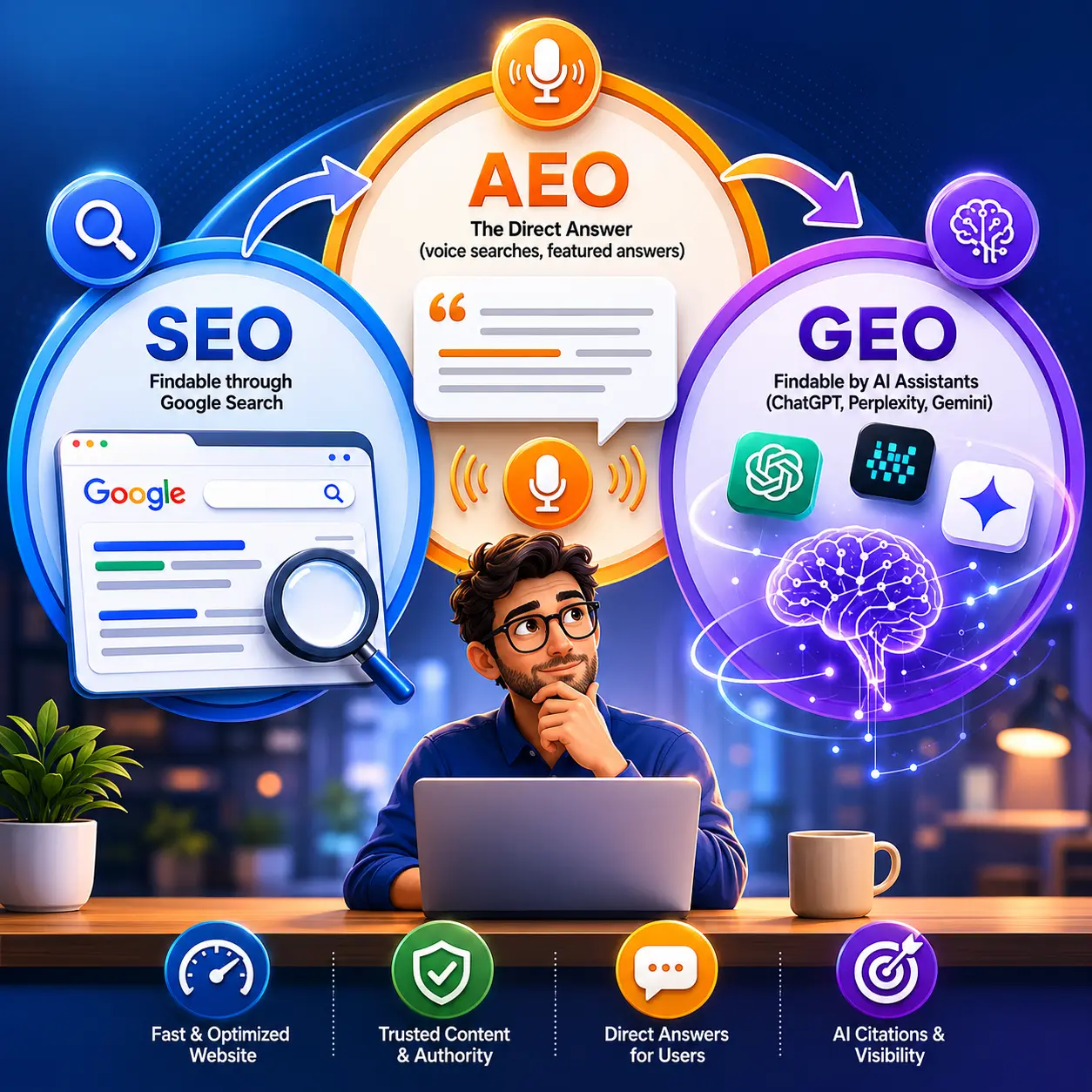
SEO = Findable through Google Search
AEO = The Direct Answer (voice searches, featured answers, etc.)
GEO = Findable by ChatGPT, Perplexity and other AI assistants
They all have different locations that can potentially host your customer. Neglect any of them, and you become invisible to part of your target audience.
SEO in 2026: Still the Base, but It’s Evolved
SEO isn’t obsolete. Far from it. However, SEO has evolved quite dramatically since 2015.
In 2015, it was all about putting as many keywords as possible on a page and getting rankings. Those times are over. Today, Google asks a crucial question: can this website be trusted by its users?
Most important SEO trends today:
Website loading speed – The ideal loading time is below 2.5 seconds; anything above will result in lost ranking points.
Author credibility – Is the author credible? Does he/she have a LinkedIn account? Has the writer published anywhere else? Google verifies all this, especially when it comes to healthcare, finances, and legal information.
Actual backlinks from credible sources – links from industry-related blogs, publications, and credible writers count. Links from any random directory do not.
And one more important factor that many ignore is that AI-based search engines use SEO information to determine whether to cite you or not.
AEO in 2026: Write for People Wanting Answers Immediately
Do you remember when you asked Siri a question and received an oral response? That’s AEO in action.
It involves being THE answer and not one of several options. The entire concept is developed with people in mind who aren’t willing to read an entire article. They just need an answer, and they need it immediately.
Writing guidelines for AEO:
Traditionally, writers introduce their topics with an introduction, followed by some background information, then the actual explanation, which leads to an answer that’s always buried somewhere inside the fifth paragraph. Not anymore.
State the answer first. Then elaborate on it.
For instance, in case your heading is called “What is Answer Engine Optimization?” — the next sentence following it needs to be an answer stated clearly and concisely in just 2–3 sentences.
Here’s what to include in your AEO content:
- Change your headings from topic-related titles to question phrases (“How do I do X?” and not “Doing X”)
- Answer in 40–60 words immediately after your headings
- Use bullet points — they make sense when voice assistants are used
- Include FAQ sections at the end of every piece
- Use FAQ schema so Google knows your answers are useful
Don’t miss: Best Digital Marketing Agency in Delhi NCR
GEO in 2026: Getting Cited by AI Tools
That is the latest development and the most interesting shift in search for the last ten years.
GEO refers to being in a position where, when asked a question by ChatGPT, Perplexity, or AI Overview on Google, your content is the one selected by the AI.
How do these AI tools work? They take information from different sources and compile a response. In essence, your task would be to become a source worth taking.
What would make AI tools cite you?
Original data – Having unique data would help in getting cited by an AI tool. Something simple like “we conducted a survey of 50 customers and found that…” would make the difference.
Clear and factual writing style – Fluffy text will get ignored, while clear facts expressed logically within short sentences will be selected.
Quotes from named experts – Providing quotes from experts with a title helps in becoming authoritative.
Links to trustworthy sources – Referencing papers, government data, popular websites helps the AI realize that the text belongs to the “trusted discussion.”
AEO vs GEO vs SEO in 2026: Quick Comparison
| SEO | AEO | GEO | |
| Goal | Get traffic from Google | Be the instant answer | Get cited by AI tools |
| Where | Google, Bing | Featured snippets, voice search | ChatGPT, Perplexity, Gemini |
| Content style | Detailed, long-form | Short, direct answer | Data-rich, expert-cited |
| Key metric | Rankings and clicks | Snippet wins | AI citation frequency |
| Schema to use | Article, Breadcrumb | FAQPage, HowTo | Organization, Person |
But How Do You Do All That Simultaneously?
The great thing is, these AEO vs GEO vs SEO in 2026 are actually connected.
Firstly, start with SEO. Optimize your site for search engines, and ensure your site runs fast, has the right structure, utilizes schema markup, and has credible authors. Without these prerequisites, you can forget about doing the other two.
Next, integrate AEO. Reformat your old content. Incorporate answers to questions beneath the headings. Convert headings into questions. Include FAQ sections. Just that alone will help you gain featured snippets quickly.
Finally, move on to GEO and add new value to your pages. Introduce unique data. Reference reputable people. Ensure that bots can crawl your site. Develop your brand entity online.
You don’t have to implement all three flawlessly on day one. Start where you are and progress from there.
Conclusion
Search in 2026 doesn’t mean anything by itself. It means three searches that happen simultaneously.
One person is searching on Google. Another is asking Siri. Yet another is asking ChatGPT for comparative analysis before making a decision. This is what AEO vs GEO vs SEO in 2026 is. Your business needs to appear in all three searches — not any of the three.
The team at Clever Clicks has worked with brands across industries making this exact shift — from chasing one ranking to owning all three search surfaces.
Build from where you are. Improve the foundation. Add the answer layer. Finally, earn your AI citations.
That is how the game is played now.
FAQ
What is the difference between AEO, GEO, and SEO in 2026?
SEO helps websites rank on Google. AEO helps content appear in featured snippets and voice search. GEO helps AI tools like OpenAI ChatGPT and Perplexity AI Perplexity cite your content.
Is SEO still important in 2026?
Yes. SEO is the foundation of online visibility. Strong SEO helps both search engines and AI tools trust your website.
What is AEO?
AEO (Answer Engine Optimization) helps your content appear as direct answers in voice search and featured snippets using clear formatting and FAQ schema.
What is GEO?
GEO (Generative Engine Optimization) helps AI platforms understand and mention your content in AI-generated answers.
Do I need SEO, AEO, and GEO together?
Yes. SEO brings Google traffic, AEO wins instant answers, and GEO increases AI citations. Together, they improve visibility everywhere people search.