Growing a direct-to-consumer (D2C) brand in 2026 requires more than launching advertisements and hoping customers will buy. Ecommerce founders must attract the right audience, build trust, convert website visitors into paying customers, and maintain profitability while scaling.
Many D2C businesses invest heavily in paid advertising but struggle to generate consistent sales. Others publish blogs and optimise their websites for search engines but fail to turn organic traffic into revenue. Some brands receive thousands of website visitors every month but still experience low conversion rates.
The underlying problem is often that marketing channels operate independently instead of supporting one another.
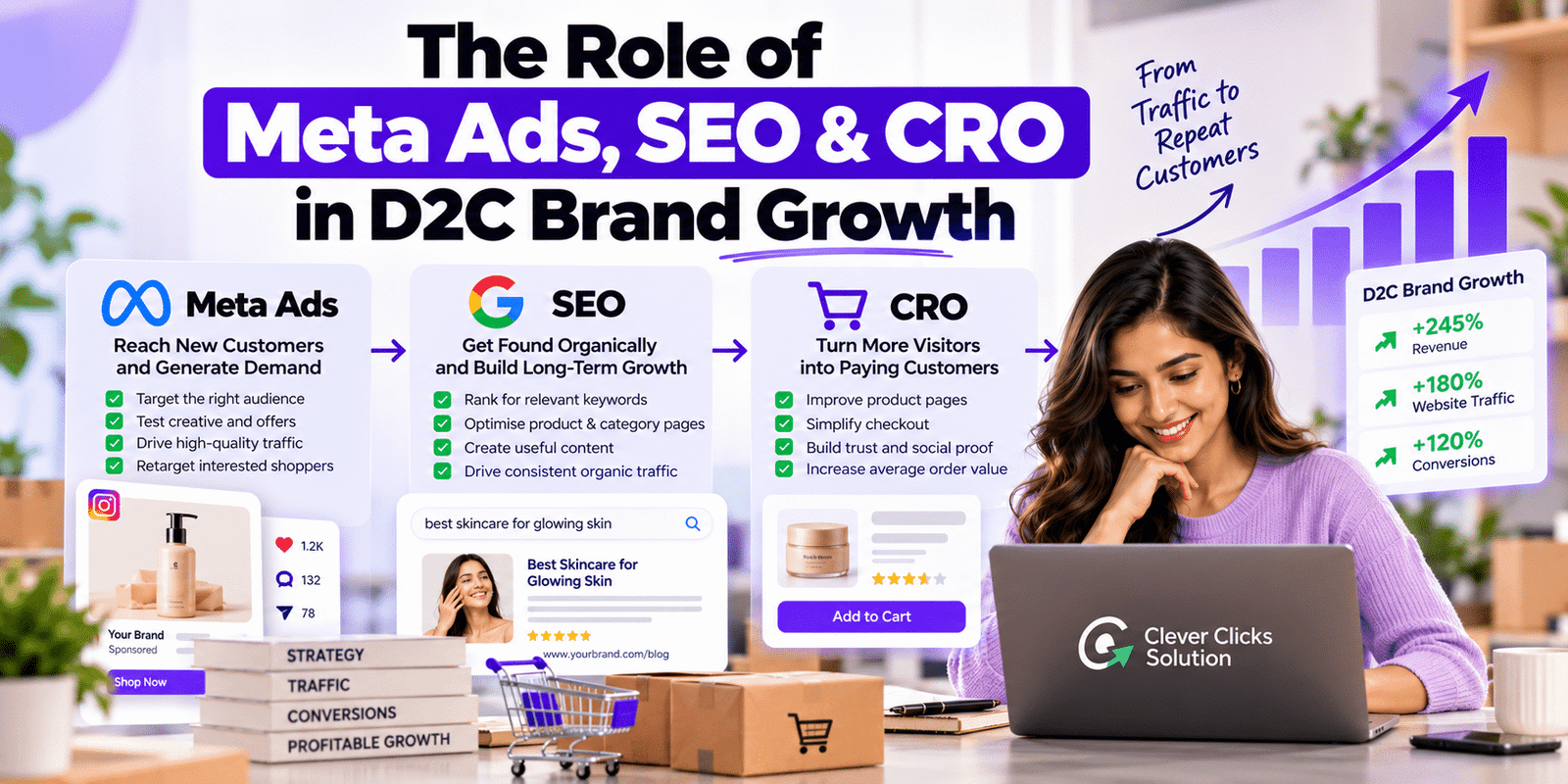
This is where Meta Ads, SEO, and Conversion Rate Optimisation (CRO) become important. Together, these three capabilities help D2C brands acquire customers, improve online visibility, and generate more value from their existing website traffic.
For D2C founders, understanding how these channels work together can help reduce wasted marketing spend, identify growth opportunities, and build a more sustainable ecommerce business.
At Clever Clicks Solution, we approach D2C brand growth by connecting performance marketing, organic acquisition, creative strategy, and website optimisation. The objective is not simply to increase clicks or traffic. It is to help brands build a marketing system that supports measurable business outcomes.
In this guide, we will explain how Meta Ads, SEO, and CRO work, why each matters to ecommerce owners, and how combining them can create stronger opportunities for long-term growth.
What Is D2C Brand Growth?
D2C brand growth refers to increasing a direct-to-consumer business’s revenue, customer base, market presence, and long-term customer value through direct sales channels.
Unlike businesses that depend primarily on distributors or retailers, D2C brands can build direct relationships with their customers through ecommerce websites, social media, search engines, and other digital channels.
However, increasing revenue is not the only measure of success.
Sustainable D2C brand growth also requires attention to:
- Customer Acquisition Cost (CAC)
- Return on Ad Spend (ROAS)
- Average Order Value (AOV)
- Website Conversion Rate
- Contribution Margin
- Repeat Purchase Rate
- Customer Lifetime Value (LTV)
- Marketing Efficiency Ratio (MER)
These metrics help founders understand whether marketing investments are producing commercially meaningful results.
For example, a brand might double its website traffic without increasing sales. Another brand might maintain the same traffic volume but generate more revenue by improving its product pages and checkout experience.
Both situations demonstrate why growth requires a combination of customer acquisition and conversion optimisation.
Why Meta Ads, SEO, and CRO Matter for D2C Brands
Each marketing channel solves a different problem.
Meta Ads helps brands reach potential customers and generate demand through paid advertising.
SEO helps customers discover products and information through organic search.
CRO helps businesses convert a greater proportion of their existing website visitors into customers.
When these channels work together, they can support a more complete customer acquisition strategy.
| Marketing Channel | Primary Role | How It Helps D2C Owners |
|---|---|---|
| Meta Ads | Paid customer acquisition | Reaches relevant audiences and tests product messaging |
| SEO | Organic visibility | Attracts visitors searching for products and solutions |
| CRO | Conversion improvement | Helps turn more qualified visitors into customers |
| Combined strategy | Integrated growth | Connects traffic acquisition with website performance |
For a D2C owner, the key is understanding which channel addresses the business’s current bottleneck.
If the brand lacks traffic, acquisition may be the priority. If traffic is already strong but sales remain weak, the website and conversion funnel may need attention. If paid advertising generates sales but acquisition costs are difficult to sustain, SEO and retention may become increasingly important.
1. How Meta Ads Help D2C Brands Generate Sales
Meta Ads, which includes advertising across Facebook and Instagram, is an important customer acquisition channel for many ecommerce businesses.
It allows brands to promote products through images, videos, carousels, creator-style content, and other advertising formats.
Unlike search advertising, which often captures existing demand, Meta Ads can introduce a product to people who may not have been actively looking for it.
For example, a skincare brand can use a video to demonstrate its product, explain its benefits, and introduce its offer to a relevant audience.
How Meta Ads support D2C growth
A. Reach potential customers
Meta Ads can help businesses reach audiences based on available targeting options, campaign objectives, creative signals, and platform optimisation.
For D2C owners, this creates opportunities to introduce products to new customers without relying exclusively on organic reach.
B. Test different creative angles
Creative testing helps brands understand which product messages attract attention and generate purchases.
A brand might test:
- Product demonstrations
- Customer testimonials
- UGC-style videos
- Founder-led content
- Problem-solution creatives
- Product comparisons
- Bundles and value offers
The goal is to identify which messages resonate with the intended audience and contribute to commercial outcomes.
C. Retarget interested visitors
Depending on tracking permissions, available audience data, and platform settings, brands can use retargeting to reconnect with people who have previously interacted with their website or content.
This can support the customer journey by reminding interested shoppers about products they considered but did not purchase.
D. Measure campaign performance
Meta Ads provides reporting on metrics such as impressions, clicks, purchases, and attributed revenue, depending on the campaign setup and tracking configuration.
D2C founders should evaluate these results alongside actual website sales, costs, and contribution margins rather than relying on a single platform metric.
What D2C owners should monitor in Meta Ads
| Metric | Why It Matters |
|---|---|
| CPM | Indicates the cost of reaching audiences |
| CTR | Helps assess how effectively an ad attracts clicks |
| CPC | Measures the cost of generating a click |
| CPA | Measures the cost of a defined acquisition action |
| ROAS | Compares advertising-attributed revenue with ad spend |
| Purchase Conversion Rate | Helps evaluate the effectiveness of the buying journey |
These metrics should be interpreted together. A low CPC does not automatically mean an advertisement is profitable, and a high ROAS does not necessarily mean the business is generating sufficient net profit.
Common Meta Ads mistakes D2C brands should avoid
Many brands increase advertising budgets before confirming that their campaigns, product pages, and unit economics can support additional spending.
Other common mistakes include using repetitive creatives, making frequent changes without enough evidence, relying on inaccurate tracking, and ignoring customer feedback.
For sustainable D2C brand growth, advertising decisions should be based on a combination of campaign performance, business economics, and the customer experience.
2. How SEO Helps D2C Brands Build Long-Term Organic Traffic
Search Engine Optimisation (SEO) helps websites become more visible in relevant organic search results.
When potential customers search for a product, compare alternatives, or look for advice before purchasing, a well-optimised ecommerce website has an opportunity to attract them.
Unlike paid advertising, organic search traffic does not require paying for every click. However, SEO still requires investment in content, technical improvements, optimisation, and ongoing maintenance.
How SEO contributes to D2C brand growth
A. Capture customers with purchase intent
People use search engines for different reasons.
Some are researching a problem, some are comparing products, and others are ready to buy.
A D2C brand can create content that matches these different stages of the customer journey.
For example, a home decor business might target:
- Informational searches about decorating small apartments
- Commercial searches comparing types of wall decor
- Product searches for specific home decor items
This approach helps the brand reach customers at different stages of their decision-making process.
B. Optimise product and category pages
Product and category pages are important assets for ecommerce SEO.
Optimisation may include clear product titles, useful descriptions, descriptive headings, high-quality images, relevant internal links, structured data where appropriate, and accurate product information.
These improvements help search engines understand the page and make it easier for customers to evaluate the product.
C. Build topical authority through content
Useful blog articles can answer customer questions, explain product benefits, and support product discovery.
For example, a nutrition brand could publish educational content about protein sources, ingredient comparisons, and choosing products based on dietary preferences, provided the information is accurate and appropriately qualified.
Relevant articles can also link to related categories and products, creating a more connected website structure.
D. Reduce dependence on paid acquisition over time
A strong SEO programme can generate organic traffic that complements paid advertising.
This does not mean SEO will replace Meta Ads or that organic traffic is free to acquire. SEO requires ongoing resources, and rankings depend on competition, website quality, search demand, and many other factors.
However, a broader acquisition mix can help a business avoid depending entirely on one advertising platform.
Important SEO activities for D2C owners
A practical ecommerce SEO strategy should consider:
- Keyword research based on search intent
- Product and category page optimisation
- Technical SEO and indexability
- Website speed and mobile usability
- Internal linking
- Helpful blog content
- Image optimisation
- Relevant structured data
- Search Console monitoring
- Content updates based on performance
For D2C brand growth, SEO should be connected to the products and commercial goals of the business, rather than focusing only on increasing page views.
3. How CRO Turns Website Visitors Into Paying Customers
Conversion Rate Optimisation (CRO) is the process of improving the proportion of website visitors who complete a desired action, such as making a purchase.
This is especially important for ecommerce businesses because attracting visitors is only part of the sales process.
A website may receive substantial traffic but still struggle to convert visitors if its product pages are unclear, pricing is confusing, trust signals are weak, or checkout is difficult.
Why CRO matters to D2C owners
Suppose an ecommerce website receives 10,000 sessions per month and converts 1% of those sessions into orders.
That represents 100 orders.
If the conversion rate increases to 1.5%, the same 10,000 sessions could produce 150 orders, assuming the traffic mix and other conditions remain comparable.
<box border radius=”lg” padding={4} gap={3}> <title size=”lg”>Illustrative CRO opportunity</title> <grid columns={2} gap={3}> <grid-item> <text color=”secondary” size=”sm”>Current conversion rate</text> <title size=”2xl” color=”default”>1%</title> <text color=”secondary” size=”sm”>100 orders per 10,000 sessions</text> </grid-item> <grid-item> <text color=”secondary” size=”sm”>Improved conversion rate</text> <title size=”2xl” color=”success”>1.5%</title> <text color=”secondary” size=”sm”>150 orders per 10,000 sessions</text> </grid-item> </grid> <divider color=”subtle”/> <text weight=”medium”>Illustrative difference: 50 additional orders from the same number of sessions.</text> <text color=”secondary” size=”xs”>This is a hypothetical example, not a guaranteed result. Actual outcomes depend on traffic quality, implementation, and customer behaviour.</text> </box>
This example demonstrates why CRO can be valuable. A brand may be able to generate more orders without proportionally increasing its traffic acquisition budget.
Five CRO improvements worth evaluating
1. Improve product pages
Product pages should answer the questions customers need resolved before buying.
Include clear product benefits, specifications, images, pricing, shipping details, returns information, and relevant reviews.
2. Improve mobile shopping experience
Many ecommerce customers browse on mobile devices. Ensure that product information is readable, buttons are accessible, images load efficiently, and the checkout experience works smoothly on smaller screens.
3. Make the offer clear
Customers should understand what they are buying, what it costs, and what value they receive.
Bundles, quantity options, and complementary products may increase AOV when they suit customer needs and preserve healthy margins.
4. Reduce checkout friction
Unexpected costs, confusing forms, limited payment options, and unclear delivery timelines can create purchasing hesitation.
Review checkout analytics and customer feedback to identify where shoppers are leaving.
5. Build trust
Clear contact details, authentic reviews, transparent policies, secure payment options, and accurate product information can help customers feel more confident about purchasing.
The best CRO strategy is not based on assumptions alone. It uses analytics, customer feedback, usability reviews, and experiments to identify improvements that genuinely help the buying journey.
4. Why Meta Ads, SEO, and CRO Work Better Together
Each channel can deliver value independently, but their combined effect becomes clearer when they support the same customer journey.
Consider a D2C brand selling premium skincare products.
Meta Ads introduces the product to potential customers through demonstrations and creator-style content. SEO helps customers discover the brand when researching skincare concerns or comparing products. CRO makes the website easier to navigate, understand, and purchase from.
The channels reinforce one another by addressing different parts of the buying process.
How the integrated growth process works
<box border radius=”lg” padding={3} gap={2}> <box background=”surface-secondary” radius=”md” padding={3} align=”center” gap={1}> <icon name=”megaphone” size=”xl”/> <title size=”md”>Meta Ads</title> <text color=”secondary” textAlign=”center” size=”sm”>Reach new audiences and generate demand</text> </box> <row justify=”center”> <icon name=”arrow-down” size=”xl” color=”secondary”/> </row> <box background=”surface-secondary” radius=”md” padding={3} align=”center” gap={1}> <icon name=”search” size=”xl”/> <title size=”md”>SEO</title> <text color=”secondary” textAlign=”center” size=”sm”>Capture relevant organic search demand</text> </box> <row justify=”center”> <icon name=”arrow-down” size=”xl” color=”secondary”/> </row> <box background=”surface” border radius=”md” padding={3} align=”center” gap={1}> <icon name=”shopping-cart” size=”xl”/> <title size=”md”>CRO</title> <text color=”secondary” textAlign=”center” size=”sm”>Improve the website’s ability to convert visitors</text> </box> <row justify=”center”> <icon name=”arrow-down” size=”xl” color=”secondary”/> </row> <box background=”surface-secondary” radius=”md” padding={3} align=”center” gap={1}> <icon name=”chart-no-axes-combined” size=”xl”/> <title size=”md”>Measure and Improve</title> <text color=”secondary” textAlign=”center” size=”sm”>Use sales and conversion data to guide the next decisions</text> </box> </box>
This is a simplified model, not a strictly linear customer journey. Customers may discover a product through social media, research it on Google, return through a direct visit, and purchase days later.
For D2C owners, the key benefit is that marketing decisions become more connected.
Rather than asking only how to increase advertising spend, the business can ask:
- Are the right people reaching the website?
- Are we visible when customers search for our products?
- Are visitors finding the information they need?
- Where are potential customers leaving?
- Which changes improve completed purchases and contribution margin?
These questions help identify the highest-priority growth opportunities.
5. How D2C Owners Can Decide Which Channel to Prioritise
Not every brand should invest equally in Meta Ads, SEO, and CRO from day one.
The appropriate priority depends on the brand’s stage, budget, current performance, and customer acquisition requirements.
| Business situation | Potential priority | Reason |
|---|---|---|
| New brand with little traffic | Product validation and targeted acquisition | Generate initial demand and learn from customer behaviour |
| Strong traffic but few orders | CRO and customer research | Investigate conversion barriers |
| Heavy dependence on paid advertising | SEO and channel diversification | Build additional acquisition opportunities |
| High advertising costs | Unit economics, creative testing, and CRO | Improve acquisition efficiency |
| Strong first purchases but weak repeat orders | Retention and customer experience | Improve customer lifetime value |
| Established brand expanding categories | Integrated Meta Ads, SEO, and CRO | Support growth across acquisition and conversion |
These priorities are starting points, not universal rules. For example, a brand with weak product-market fit should not simply increase advertising or publish more content before understanding why customers are not purchasing.
- Test new advertising creatives and messages.
- Improve priority product and category pages.
- Fix important technical SEO issues.
- Clarify product benefits, shipping information, and returns policies.
- Test specific CRO improvements where sufficient data is available.
Days 61–90: Evaluate and refine
- Compare results against the baseline.
- Identify which creatives and landing pages perform best.
- Review organic search visibility and relevant traffic.
- Evaluate conversion changes and business outcomes.
- Allocate resources to the opportunities supported by the evidence.
Ninety days is a useful planning period, not a guarantee of specific results. Paid campaigns may provide earlier signals, while SEO and some CRO experiments require more time or data.
6. Common Mistakes D2C Owners Should Avoid
Even well-funded brands can struggle when their marketing decisions are disconnected from business fundamentals.
Depending entirely on Meta Ads
Paid acquisition can be valuable, but relying on a single channel exposes a business to platform changes, auction competition, and fluctuations in campaign performance.
Consider developing other suitable acquisition channels as the business matures.
Publishing SEO blogs without a strategy
Content should serve customer needs and connect with relevant product categories. Publishing large quantities of generic articles without considering search intent, quality, and internal linking may produce limited commercial value.
Optimising for traffic instead of purchases
More traffic is not always better if the visitors are unlikely to buy. Evaluate whether the content, targeting, and landing pages attract the right audience.
Making website changes without measurement
Changing multiple elements at once can make it difficult to understand why performance improved or declined. Where practical, test defined hypotheses and evaluate results using reliable data.
Ignoring profit margins
Revenue growth is not equivalent to profit growth. Monitor product costs, fulfilment, returns, discounts, advertising spend, and other relevant expenses when evaluating the effectiveness of marketing.
7. How Clever Clicks Solution Helps D2C Brands Connect Meta Ads, SEO, and CRO
Clever Clicks Solution approaches D2C marketing as an integrated growth process, combining performance marketing, SEO, creative strategy, Shopify website development, and conversion-focused optimisation.
The objective is to understand where a brand’s growth is being constrained and determine which improvements deserve priority.
Performance marketing
We help businesses structure paid acquisition around campaign objectives, creative testing, tracking, and measurable performance.
Meta Ads and other paid channels can support customer acquisition when the offer, audience, website experience, and unit economics are aligned.
SEO and content strategy
Our SEO approach focuses on relevant keywords, technical health, product and category pages, useful content, internal linking, and organic search visibility.
The goal is to help brands reach customers who are actively researching or looking for relevant products.
Shopify development and CRO
A website should support the buying journey rather than create unnecessary friction.
Shopify development and conversion-focused improvements can address product presentation, navigation, mobile usability, speed, and checkout experience.
The appropriate changes depend on the website’s current performance and customer needs.
The Clever Clicks 5D growth framework
Our framework connects these activities through five stages:
Diagnose: Evaluate the business, audience, acquisition channels, website, and performance data.
Differentiate: Clarify the brand’s value proposition and product messaging.
Demand: Build demand through relevant paid and organic channels.
Deploy: Implement campaigns, creative testing, SEO improvements, and conversion initiatives.
Dominate: Expand the approaches that demonstrate sustainable potential while improving efficiency and retention.
For D2C owners, this provides a structured way to prioritise marketing investments rather than treating every channel as a separate project.
No agency can guarantee a particular revenue outcome for every business. Product demand, competition, margins, inventory, fulfilment, and other operational factors also influence results. The goal is to develop a strategy grounded in the brand’s circumstances and improve it through measurement.
Conclusion: Build a Connected D2C Growth Strategy
Meta Ads, SEO, and CRO solve different but closely related problems.
Meta Ads helps brands reach potential customers and generate demand. SEO helps customers discover products through organic search. CRO helps convert qualified website visitors into paying customers.
For D2C owners, the real opportunity lies in connecting all three.
A brand that attracts relevant visitors, provides useful product information, delivers a smooth buying experience, and measures performance accurately is better positioned to identify sustainable growth opportunities.
At Clever Clicks Solution, we help D2C businesses connect performance marketing, SEO, Shopify development, and conversion-focused optimisation within a structured growth strategy.
If your business is investing in advertising but struggling to improve sales, or generating organic traffic without enough purchases, the next step is to identify the specific bottleneck in your acquisition and conversion process.
The objective is not simply to attract more visitors. It is to turn the right traffic into customers and build a stronger, more sustainable ecommerce business.
Frequently Asked Questions About Meta Ads, SEO, and CRO for D2C Brands
1. What is the role of Meta Ads in D2C brand growth?
Meta Ads helps D2C brands reach potential customers through Facebook and Instagram advertising. Brands can test different creatives, promote products, generate demand, and measure campaign outcomes to understand which approaches contribute to customer acquisition.
2. How does SEO help D2C ecommerce brands grow?
SEO helps ecommerce brands appear in relevant organic search results. Product-page optimisation, category pages, technical SEO, and helpful content can improve discoverability and create additional opportunities to attract customers over time.
3. What is CRO in ecommerce marketing?
Conversion Rate Optimisation is the process of improving the percentage of website visitors who complete a desired action, such as purchasing a product. It can involve improving product pages, mobile usability, trust signals, offers, and checkout experience.
4. Should D2C brands invest in Meta Ads, SEO, and CRO together?
These channels can complement one another, but investment priorities depend on the business. Meta Ads can support acquisition, SEO can build organic visibility, and CRO can improve website performance. A brand should prioritise the areas most likely to address its current bottlenecks.
5. How can a D2C brand increase online sales?
A D2C brand can investigate customer targeting, creative performance, product positioning, website conversion, pricing, and customer retention. Increasing sales sustainably requires identifying the actual constraints and measuring whether changes improve commercial outcomes.
6. What is a good ROAS for Meta Ads for D2C brands?
A good ROAS depends on product margins, fulfilment costs, discounts, returns, and other variable expenses. Brands should calculate their break-even requirements and profit targets rather than relying on a universal ROAS benchmark.
7. How long does SEO take to generate results for ecommerce brands?
SEO timelines vary according to competition, website quality, search demand, technical issues, and content relevance. Some changes can produce earlier signals, but meaningful organic growth often requires sustained optimisation and monitoring.
8. How can D2C owners reduce customer acquisition costs?
Brands can review creative performance, traffic quality, targeting, offers, landing pages, conversion rates, and retention. The best approach depends on what is causing acquisition costs to rise and whether the changes preserve profitability.
9. Why is conversion rate optimisation important for Shopify stores?
CRO helps identify opportunities to improve the shopping experience and increase the proportion of visitors who purchase. Shopify improvements may include clearer product information, better mobile usability, transparent shipping details, and simpler checkout processes.
10. What is the difference between SEO and paid advertising?
Paid advertising provides traffic through campaigns funded by an advertising budget. SEO focuses on improving organic visibility in search results. Both require investment, but they operate differently and can complement one another within a broader acquisition strategy.
11. Can SEO reduce dependence on Meta Ads?
SEO can provide an additional source of traffic and customer acquisition, potentially reducing dependence on paid channels over time. However, results depend on the brand’s search demand, competition, website quality, and SEO execution.
12. What metrics should D2C owners track?
Important metrics include CAC, CPA, ROAS, AOV, conversion rate, contribution margin, repeat purchase rate, LTV, and MER. The business should define these metrics consistently and interpret them alongside revenue and operating costs.
13. How does creative testing improve Meta Ads performance?
Creative testing helps identify which hooks, product demonstrations, offers, and formats resonate with potential customers. Testing provides evidence for future creative decisions instead of relying entirely on assumptions.
14. How can a D2C brand improve its ecommerce conversion rate?
Start by reviewing analytics and customer feedback. Investigate product-page clarity, mobile usability, delivery costs, reviews, pricing, payment options, and checkout abandonment. Test improvements based on the issues identified.
15. What is the best marketing strategy for a new D2C brand?
A new brand should validate demand, clarify its product positioning, establish accurate tracking, and test suitable acquisition channels. It should also ensure that its website communicates product value and provides a reliable buying experience.
16. How does CRO improve the return on advertising spend?
If CRO increases the proportion of qualified visitors who purchase, the same amount of paid traffic may generate more orders. The actual effect on ROAS depends on traffic quality, average order value, attribution, and implementation costs.
17. Should a D2C brand hire an agency for SEO and performance marketing?
An agency can help businesses combine specialist capabilities, develop a strategy, implement campaigns, and monitor results. Before hiring one, evaluate its relevant experience, reporting, scope of work, and understanding of ecommerce economics.
18. How does Clever Clicks Solution help D2C brands grow?
Clever Clicks Solution supports D2C businesses through performance marketing, SEO, creative strategy, Shopify development, and conversion-focused optimisation. The approach connects acquisition and website performance with the brand’s business objectives.
19. Can Meta Ads and SEO work together for ecommerce growth?
Yes. Meta Ads can introduce products to audiences, while SEO can help customers discover the brand through relevant searches. Their combined use can diversify acquisition opportunities and support customers at different stages of the buying journey.
20. What should D2C founders prioritise first: Meta Ads, SEO, or CRO?
The priority depends on the business’s current performance. Brands with insufficient qualified traffic may need acquisition work, while brands with strong traffic but weak sales should investigate CRO. Businesses dependent on paid advertising may also benefit from building a suitable organic search strategy.