Table of Contents
Growing a direct-to-consumer brand in 2026 is not just about launching advertisements and waiting for orders. Competition is increasing, customer acquisition can be expensive, and customers have more choices than ever. To grow consistently, brands need a strategy that connects marketing, customer experience, and profitability. This is where a D2C marketing agency can make a meaningful difference.
Many D2C founders start with organic social media, influencer collaborations, or small advertising campaigns. These methods can generate initial sales, but scaling from a few daily orders to ₹10 lakh, ₹50 lakh, or ₹1 crore in monthly revenue requires a more structured approach.
The challenge is not simply getting more traffic. It is attracting the right customers, communicating product value, improving conversion rates, and encouraging repeat purchases.
At Clever Clicks Solution, we approach D2C growth as a connected system rather than a collection of separate marketing activities. The objective is to help ecommerce businesses identify growth opportunities, improve customer acquisition, and build a stronger foundation for sustainable revenue.
In this guide, we will explain what makes a marketing partner valuable, which services matter most, how to evaluate agencies, and how to choose the right growth strategy for your business in 2026.
What Is a D2C Marketing Agency?
A D2C marketing agency specialises in helping direct-to-consumer brands acquire customers and grow through digital channels. Unlike traditional businesses that primarily depend on distributors or retailers, D2C brands sell directly to their customers through ecommerce websites, social media, and other digital platforms.
A specialised agency understands the relationship between advertising performance, ecommerce conversion rates, product margins, average order value, and customer retention.
For example, a skincare brand might generate traffic through Meta Ads, capture high-intent searches through Google Ads, build organic visibility through SEO, and increase repeat purchases through email or WhatsApp marketing.
A capable D2C marketing agency coordinates these activities around the brand’s commercial objectives.
Its responsibilities may include:
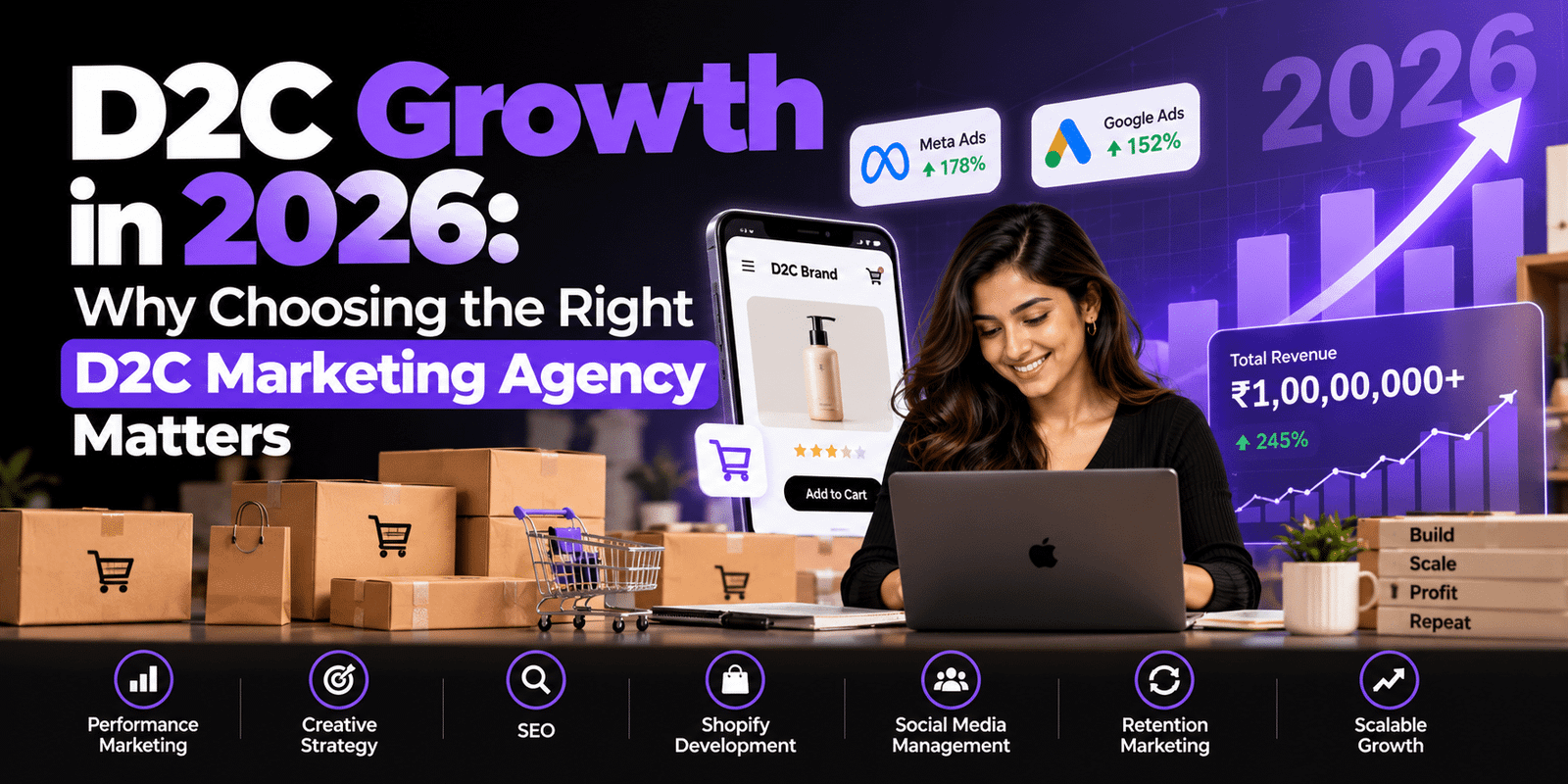
- Performance marketing through Meta Ads and Google Ads.
- Creative strategy, UGC, and product-focused advertising.
- Ecommerce SEO and content marketing.
- Shopify website development and conversion rate optimisation.
- Social media management and brand communication.
- Retargeting, customer retention, and remarketing.
- Analytics, reporting, and marketing performance reviews.
However, not every brand needs every service immediately. The right mix depends on the product, margins, target audience, competition, and stage of growth.
Why D2C Brands Need a Specialised Marketing Strategy in 2026
The ecommerce market continues to evolve. Advertising platforms introduce new capabilities, customers compare products across multiple channels, and brands compete for attention through videos, creator content, search results, and personalised offers.
Consequently, relying on a single marketing channel can create unnecessary risk.
1. Customer acquisition requires better planning
Paid advertising can help brands reach new customers quickly. However, spending more does not automatically generate more profitable sales.
Brands need to understand how much they can afford to spend to acquire a customer, how much revenue each order generates, and how much margin remains after fulfilment and other variable costs.
A D2C marketing agency should help founders connect advertising decisions with these business numbers instead of focusing only on clicks and impressions.
2. Creative quality influences campaign performance
Customers scroll past countless advertisements every day. A generic product image or repetitive discount message may struggle to communicate why a product deserves attention.
Brands need a consistent process for testing different hooks, product demonstrations, customer testimonials, founder-led videos, and problem-solution creatives.
The objective is to discover which messages attract qualified customers and encourage purchases.
3. Website conversion matters as much as traffic
Imagine that a brand spends money attracting 10,000 visitors, but only a small percentage purchase. Increasing traffic without addressing the conversion problem may simply increase costs.
Product pages, mobile usability, website speed, reviews, pricing, shipping information, and checkout experience all influence purchasing decisions.
Therefore, marketing performance should be evaluated across the entire customer journey.
4. Customer retention supports long-term growth
Acquiring a new customer is only one part of the business.
Depending on the product category, brands can also generate revenue through repeat purchases, replenishment reminders, complementary products, bundles, loyalty programmes, and personalised communication.
A good growth strategy considers both new customer acquisition and existing customer value.
How to Choose the Right D2C Marketing Agency
Choosing an agency is a business decision, not simply a search for the lowest monthly retainer.
The right partner should understand your commercial objectives, explain its approach clearly, and provide a transparent process for measuring performance.
1. Check experience with your business model
An agency experienced in local lead generation may not automatically understand the challenges of scaling an ecommerce brand.
Ask whether the team understands product margins, customer acquisition costs, return rates, average order value, inventory constraints, and repeat purchase behaviour.
A specialist D2C marketing agency should be able to explain how these factors affect its marketing recommendations.
2. Evaluate its performance marketing process
Do not judge an agency only by its promises about ROAS or revenue.
Ask how it structures campaigns, tests creatives, evaluates audiences, checks tracking accuracy, and decides when to scale or pause advertising.
A reliable process should explain what the team will test, which metrics it will monitor, and how it will use the findings to make decisions.
3. Review relevant case studies
Case studies can help you understand how an agency approaches real business challenges.
Look for the starting position, campaign strategy, timeframe, marketing investment where disclosed, and actual results. Also check whether the results refer to attributed advertising revenue, total website revenue, or overall business revenue.
These numbers are not interchangeable.
Clever Clicks Solution can present relevant work and project examples to prospective clients where the information is available and approved for disclosure. Results should always be interpreted in the context of the brand’s circumstances.
4. Understand the reporting structure
Your agency should explain performance in a way that supports business decisions.
A useful report goes beyond impressions and clicks. It should connect campaign activity with spend, purchases, acquisition costs, revenue, and profitability considerations.
For example, if ROAS improves but contribution margin falls, the team should investigate why before increasing the budget.
5. Look for strategic thinking
An agency should not recommend the same strategy to every business.
A newly launched brand may need product positioning, offer testing, and early customer acquisition. A mature brand may need better creative production, improved conversion rates, channel diversification, and retention systems.
The strategy should reflect your current bottlenecks rather than a fixed service checklist.
Which Services Should a D2C Marketing Agency Provide?
The right services depend on your growth stage. However, several capabilities are particularly relevant to ecommerce businesses.
Performance marketing for customer acquisition
Performance marketing helps brands acquire customers through measurable advertising campaigns.
Meta Ads can introduce products to relevant audiences and stimulate demand. Google Ads can capture users who are actively searching for products or solutions.
A D2C marketing agency should select campaign objectives, budgets, and channels according to the brand’s goals and unit economics.
Its work may include campaign setup, audience testing, creative testing, conversion tracking, retargeting, and regular optimisation.
Creative strategy and UGC
Creative production is an important part of paid acquisition.
A brand can test multiple approaches, including product demonstrations, customer reviews, creator-led videos, unboxing content, comparisons, and founder explanations.
For instance, a fashion brand might test styling videos, fabric close-ups, customer try-ons, and occasion-based messaging.
Rather than assuming one format will always work, the team should evaluate performance and develop new variations based on what it learns.
Ecommerce SEO
SEO helps customers discover products and brands through organic search.
A strong ecommerce SEO strategy can include technical improvements, category-page optimisation, product-page content, internal linking, useful blog articles, and keyword research.
For example, a home decor brand could target commercial searches for relevant products while publishing helpful content about room styling, material selection, and product care.
SEO typically takes time, and rankings or traffic cannot be guaranteed. However, consistent work can strengthen organic visibility and reduce dependence on paid acquisition over the long term.
Shopify website development and conversion optimisation
Your website is where many customers make their final purchasing decision.
A conversion-focused Shopify store should provide clear product information, persuasive imagery, accessible navigation, transparent delivery details, and a smooth mobile checkout experience.
Clever Clicks Solution offers Shopify website development alongside marketing services, allowing brands to consider website improvements as part of the wider growth strategy.
Social media and retention marketing
Social media helps establish brand identity, build familiarity, and communicate product value.
Meanwhile, email and WhatsApp marketing can support abandoned-cart recovery, product education, repeat purchases, and customer updates when implemented with appropriate consent and communication practices.
Together, these channels can create a more connected customer experience.
How a D2C Marketing Agency Helps Brands Scale Revenue
Scaling requires different priorities at different stages. Increasing advertising spend is only one possible growth lever.
Stage 1: Establish a reliable foundation
At the beginning, brands need to validate their offer, identify their audience, and establish accurate tracking.
The focus should be on understanding customer objections, testing product messaging, and ensuring that the website can support the buying process.
Stage 2: Identify repeatable acquisition opportunities
Once early sales begin, the next step is to identify the combinations of audiences, creatives, offers, and landing pages that produce promising results.
The team should document what works, test new variations, and avoid increasing budgets based on short-term performance alone.
Stage 3: Improve conversion and order value
As traffic grows, evaluate product-page performance, cart abandonment, checkout friction, bundles, and complementary products.
Improving conversion rates or average order value can sometimes create more growth potential than increasing traffic alone.
Stage 4: Expand acquisition channels
Once the economics and operational capacity support expansion, brands can explore additional channels.
This may include Google Ads, SEO, creator partnerships, organic social media, and retention campaigns.
The goal is to diversify customer acquisition where it makes commercial sense, rather than expanding into every available channel at once.
Stage 5: Build a sustainable growth system
At higher revenue levels, businesses need more consistent reporting, creative production, inventory planning, customer support, and financial oversight.
A D2C marketing agency can support the marketing side of this process, but the brand must also maintain sufficient stock, fulfil orders reliably, manage cash flow, and protect product quality.
Sustainable growth depends on the complete business, not advertising performance alone.
How Clever Clicks Solution Helps D2C Brands Grow
Clever Clicks Solution works with a performance-focused approach to digital marketing, connecting customer acquisition, creative strategy, SEO, and ecommerce website experience.
Our aim is to help D2C founders move away from disconnected marketing activities and toward a more structured growth process.
The 5D growth framework
Diagnose: Understand the brand’s current performance, audience, competition, product economics, and conversion funnel.
Differentiate: Identify the product’s value proposition and develop messaging that explains why customers should consider the brand.
Demand: Use relevant paid and organic channels to reach prospective customers and create demand.
Deploy: Implement campaigns, creative testing, landing pages, tracking, and optimisation processes.
Dominate: Scale proven approaches where the data and business fundamentals support expansion, while improving retention and marketing efficiency.
This framework provides a practical structure for deciding what to prioritise first and what to improve next.
Why an integrated approach matters
Consider a brand that generates strong advertising traffic but has a weak product page. Increasing the advertising budget may not solve the underlying problem.
Similarly, a brand may have a high-converting website but struggle because its creative does not communicate the product’s value.
By evaluating advertising, creative, SEO, and website experience together, Clever Clicks Solution can help identify where improvements are most likely to support business objectives.
The specific services and priorities should be determined after reviewing the brand’s current position.
How Much Does a D2C Marketing Agency Cost?
The cost of hiring an agency depends on the scope of work, campaign complexity, creative requirements, number of channels, reporting needs, and level of strategic involvement.
Some agencies charge a fixed monthly retainer. Others use project-based fees or a combination of management fees and performance-linked compensation.
Before signing an agreement, clarify:
- Which services are included in the retainer.
- Whether advertising spend is separate.
- How many creatives or revisions are included.
- Who manages the website and tracking.
- How often performance reports are delivered.
- What the contract duration and exit terms are.
- How success will be measured.
A lower retainer is not necessarily cheaper in the long run if the service lacks the capabilities your business needs. Similarly, a higher fee does not automatically guarantee better results.
Evaluate the agency’s process, relevance, communication, and ability to address your specific growth challenges.
Common Mistakes D2C Founders Should Avoid
Even with a capable agency, several mistakes can limit results.
Increasing budgets too quickly: Scale campaigns based on sustained performance, not a few successful days.
Ignoring contribution margin: Revenue and ROAS alone do not establish profitability.
Changing campaigns without enough evidence: Frequent, unnecessary changes can make it harder to understand what is working.
Using the same creative for too long: Monitor creative fatigue and test new approaches when performance indicates a need.
Neglecting the website: Advertising cannot fully compensate for unclear product information or a difficult checkout experience.
Expecting immediate SEO results: Organic search growth requires consistent optimisation and depends on competition, website quality, and search demand.
Choosing an agency based only on promises: Ask for a clear plan, realistic expectations, transparent reporting, and relevant evidence.
Avoiding these mistakes creates a stronger foundation for productive collaboration between the brand and its marketing partner.
Conclusion: Choose a Growth Partner, Not Just an Advertising Vendor
D2C growth in 2026 requires more than launching campaigns. Brands need to understand their customers, communicate product value, improve conversion rates, measure unit economics, and build a repeatable acquisition process.
The right D2C marketing agency can help bring these activities together through a structured strategy and consistent optimisation. However, the best results depend on collaboration between the agency and the business, realistic expectations, and sound commercial fundamentals.
Clever Clicks Solution helps D2C businesses approach growth through performance marketing, creative strategy, SEO, Shopify development, and conversion-focused optimisation.
If your brand is ready to evaluate its current marketing performance and identify the next opportunities for growth, start with a clear assessment of your acquisition costs, conversion funnel, margins, and customer retention.
The goal is not simply to spend more on marketing. It is to build a business that can acquire customers, convert them efficiently, and grow sustainably.
Frequently Asked Questions About D2C Marketing Agencies
1. What is a D2C marketing agency?
A D2C marketing agency helps direct-to-consumer businesses acquire customers and grow through digital marketing. Services may include performance marketing, SEO, creative strategy, social media, Shopify development, and conversion rate optimisation.
2. Why do D2C brands need a specialised marketing agency?
D2C businesses need to balance customer acquisition, product margins, conversion rates, average order value, and repeat purchases. A specialised agency understands these relationships and can build a marketing strategy around the brand’s commercial objectives.
3. How do I choose the best D2C marketing agency?
Evaluate the agency’s ecommerce experience, strategic process, reporting, creative capabilities, understanding of unit economics, communication, and relevant case studies. Choose a partner that understands your specific challenges rather than relying only on revenue promises.
4. What services should a D2C marketing agency offer?
Relevant services include Meta Ads, Google Ads, performance marketing, creative testing, SEO, social media management, UGC, Shopify development, conversion rate optimisation, and customer retention. The right combination depends on the brand’s stage and goals.
5. How much does a D2C marketing agency charge in India?
Pricing varies according to the scope of work, number of channels, creative requirements, and reporting needs. Ask for a detailed proposal that separates agency fees, advertising spend, production costs, and any additional charges.
6. Is performance marketing effective for D2C brands?
Performance marketing can help D2C brands reach potential customers and measure campaign outcomes. Its effectiveness depends on product demand, creative quality, tracking, offer strength, website conversion, and acquisition economics.
7. Is Meta Ads or Google Ads better for D2C ecommerce?
Neither channel is universally better. Meta Ads can help generate demand through visual advertising, while Google Ads can capture customers searching for products. The appropriate channel depends on customer behaviour, competition, margins, and campaign performance.
8. How does SEO help a D2C brand grow?
SEO improves the opportunity for customers to discover a brand through organic search. Product pages, category pages, technical SEO, internal links, and useful content can support organic visibility and long-term acquisition.
9. What is D2C performance marketing?
D2C performance marketing is a measurable approach to customer acquisition using channels such as Meta Ads and Google Ads. It evaluates campaign outcomes using metrics such as CPA, CAC, ROAS, conversion rate, and revenue.
10. How can a D2C brand reduce customer acquisition costs?
Brands can investigate creative performance, targeting, offers, landing pages, conversion rates, and customer retention. The objective is to acquire suitable customers more efficiently without sacrificing product quality or long-term profitability.
11. What is a good ROAS for a D2C brand?
A good ROAS depends on product margins, shipping, fulfilment costs, discounts, returns, and other variable expenses. Calculate the revenue required to cover these costs before deciding whether an advertising campaign is financially viable.
12. How can a D2C brand scale from ₹10 lakh to ₹1 crore per month?
Scaling requires a combination of repeatable customer acquisition, strong creative, conversion optimisation, healthy unit economics, operational capacity, and retention. A marketing agency can support acquisition and optimisation, but no single campaign guarantees a particular revenue level.
13. Why is creative testing important in D2C marketing?
Creative testing helps identify which hooks, formats, demonstrations, and messages attract customers and generate purchases. A consistent testing process can also help brands respond to changing audience preferences and creative fatigue.
14. Can a D2C marketing agency improve Shopify conversions?
An agency with Shopify development and optimisation capabilities can help improve product pages, mobile usability, website speed, trust signals, navigation, and checkout experience. The impact should be assessed using reliable conversion data.
15. What is conversion rate optimisation in ecommerce?
Conversion rate optimisation involves improving the percentage of website visitors who complete a desired action, such as purchasing a product. It may include testing product-page layouts, offers, checkout experiences, and trust elements.
16. How important is UGC for D2C brands?
User-generated content can make product communication more relatable through demonstrations, testimonials, and customer experiences. Its effectiveness depends on the product, audience, creative execution, and how the content is used.
17. Should a D2C brand invest in social media and paid advertising together?
Combining organic social media and paid advertising can support both brand familiarity and customer acquisition. Organic content can communicate product value and build trust, while paid campaigns can distribute selected messages to relevant audiences.
18. How long does it take to see results from a D2C marketing agency?
Paid advertising can generate early data relatively quickly, but consistent performance takes testing and optimisation. SEO generally requires a longer time horizon. The timeline depends on the brand’s starting point, budget, product, competition, and execution.
19. How does Clever Clicks Solution help D2C businesses?
Clever Clicks Solution supports D2C growth through performance marketing, creative strategy, SEO, social media, Shopify development, and conversion-focused optimisation. The specific strategy is based on the brand’s requirements and growth objectives.
20. What should I prepare before hiring a D2C marketing agency?
Prepare information about your products, target audience, margins, average order value, current sales, advertising spend, website performance, inventory, and business goals. This information helps the agency assess your position and recommend relevant priorities.